The challenge
A global beverage brand services the drink equipment in one of the world’s largest restaurant chains. The service itself was strong, but the invoices that followed generated an unusually high number of disputes.
The invoice read like an internal record, full of shorthand, internal part codes, and truncated technician notes, with visits sometimes bundled into one charge with no dates. When restaurant owners called with questions, support staff often had nothing more to go on than the same confusing document.
Good service was being undermined by a hard-to-read piece of paper.
The approach
The key call was defining success as a single action: paying the invoice without calling support.
I built the strategy with Applied Game Theory around that one target action. It gave the whole team a clear test for every decision: would this help franchise owners and the managers who approve payment recognize what happened, understand the charges, and trust them? I created the brief with AGT Expert, the AI strategist I built. Work that used to take me 15 to 30 hours took less than one, and I produced versions with both Claude and Gemini to compare their thinking.
Our technical lead set the rule that kept the AI trustworthy.
AI is a translator, not an author.
Our rule for every AI-written word on the invoice
Every field traces back to real data, like service records, billing records, parts costs, and a glossary built from real invoices, and the AI works only from that data, never speculating or filling gaps. For the proof of concept, we built realistic stand-ins modeled on actual invoices where real data wasn’t available.
The glossary was my idea. I created the original to translate internal codes into plain language, then handed it to our technical lead, who evolved it throughout the project.
The design
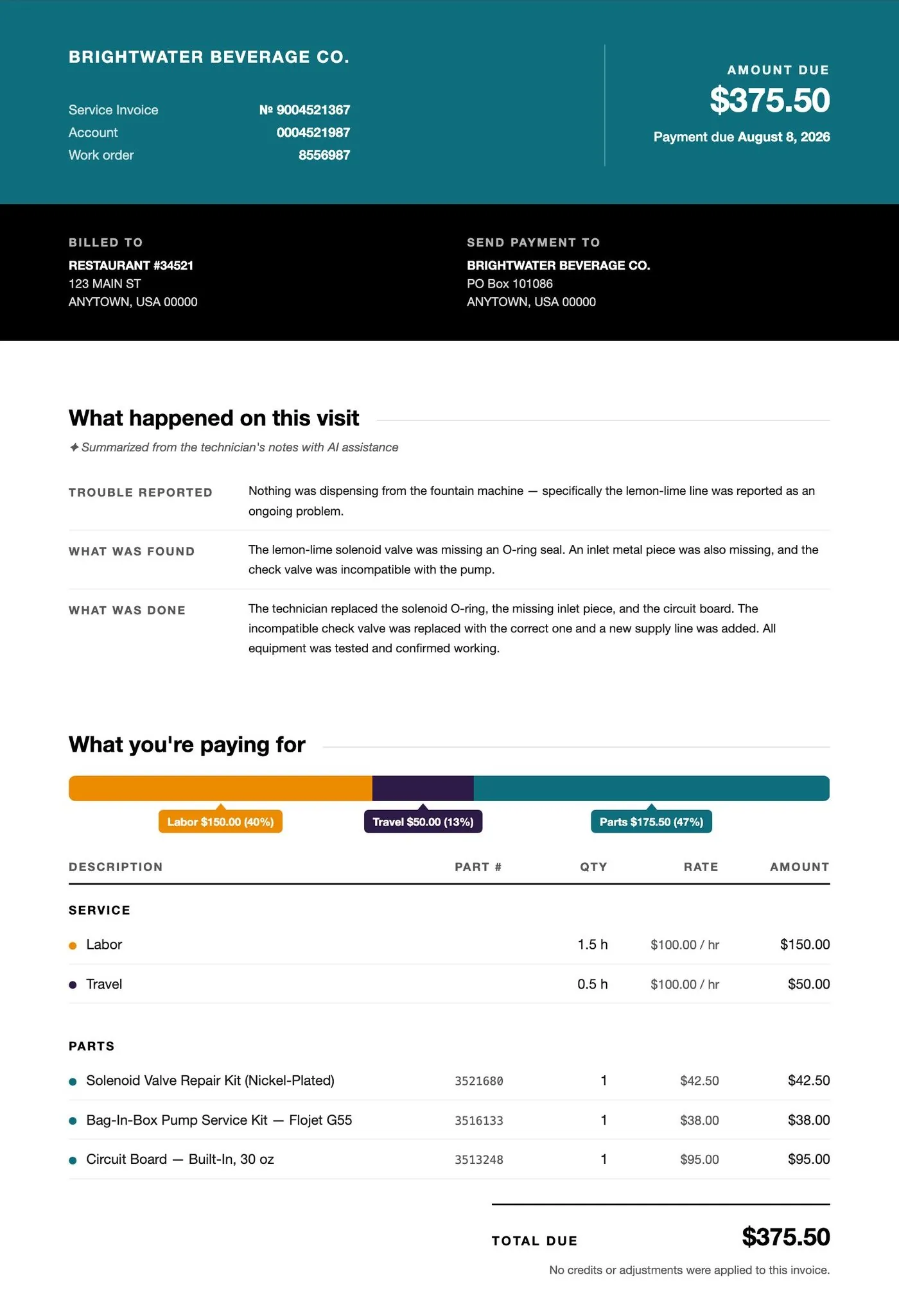
The new invoice tells an efficient story of service: what was reported, what was found, and what was done.
- What happened on this visit: an AI-written summary in three consistent points, with every acronym replaced by plain language. When technician notes are thin, the AI pieces the story together from the rest of the data.
- What you’re paying for: color-coded charges and a simple bar that shows how the total breaks down.
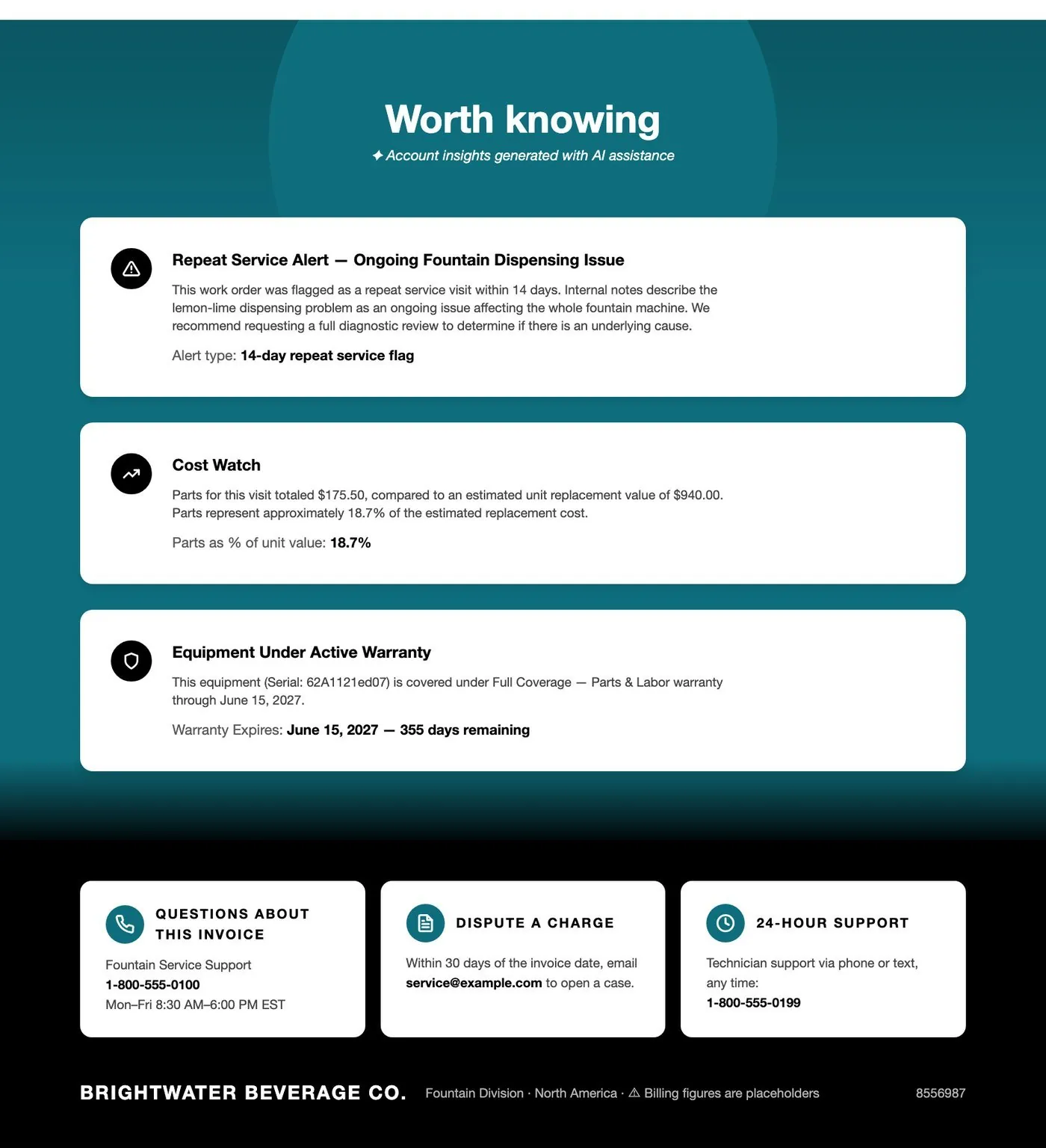
- Worth knowing: three to five personalized insights, like repeat service alerts, cost comparisons, and warranty status, that position the brand as a helpful partner, not just a biller.
- Easy next steps: clear support options for the rare times a question remains.
Our UX designer and I designed the invoice together, and I built the layout directly in HTML with Claude Code, to the client’s brand standards.
Building it
Three of us built the proof of concept in one month, collaborating closely at every step to make sure the invoice delivered on the strategy. AI wrote the code.
We made one architectural decision that paid off right away: the invoice design lives in its own file, separate from the back end that gathers the data and writes the summaries. That let us show the client two different invoice designs running on the same back end, and it means we can keep refining the design as we learn more.
What’s next
We presented the working proof of concept to the client’s leadership with a plan to scale it: research with invoice recipients, live connections to the client’s systems, and a delivery plan. We also identified a quick win: a short, AI-written service summary that fits the existing invoice template, improving invoices right away while the full redesign moves forward.
What I learned
AI changed the math of this project. A strategy brief that used to take me days took less than an hour, and three people built a working, data-driven proof of concept in a month, a pace that would have been hard to match without AI.
The real lesson is what that speed makes possible. When the first version of a strategy, a design, or a working prototype comes together quickly, we can spend our time where it matters most: testing ideas, sweating the details, and showing clients something real instead of describing it. A small team can now take on work that used to need a much bigger one.